

Elite Home & Mold Inspections

PROFESSIONAL MOLD TESTING

Mold Testing in Massachusetts & New Hampshire

Independent mold testing for homes and buildings throughout Massachusetts & New Hampshire, including Boston and Greater Boston. Air and surface samples are analyzed by an independent laboratory to help identify mold spores or suspected microbial growth. Testing is available as a standalone service or as part of a comprehensive mold inspection.

✓ 500+ Five-Star Reviews
✓ 30+ Years Combined Experience
✓ Family-Owned & Operated
✓ Independent Testing — We Do Not Perform Remediation
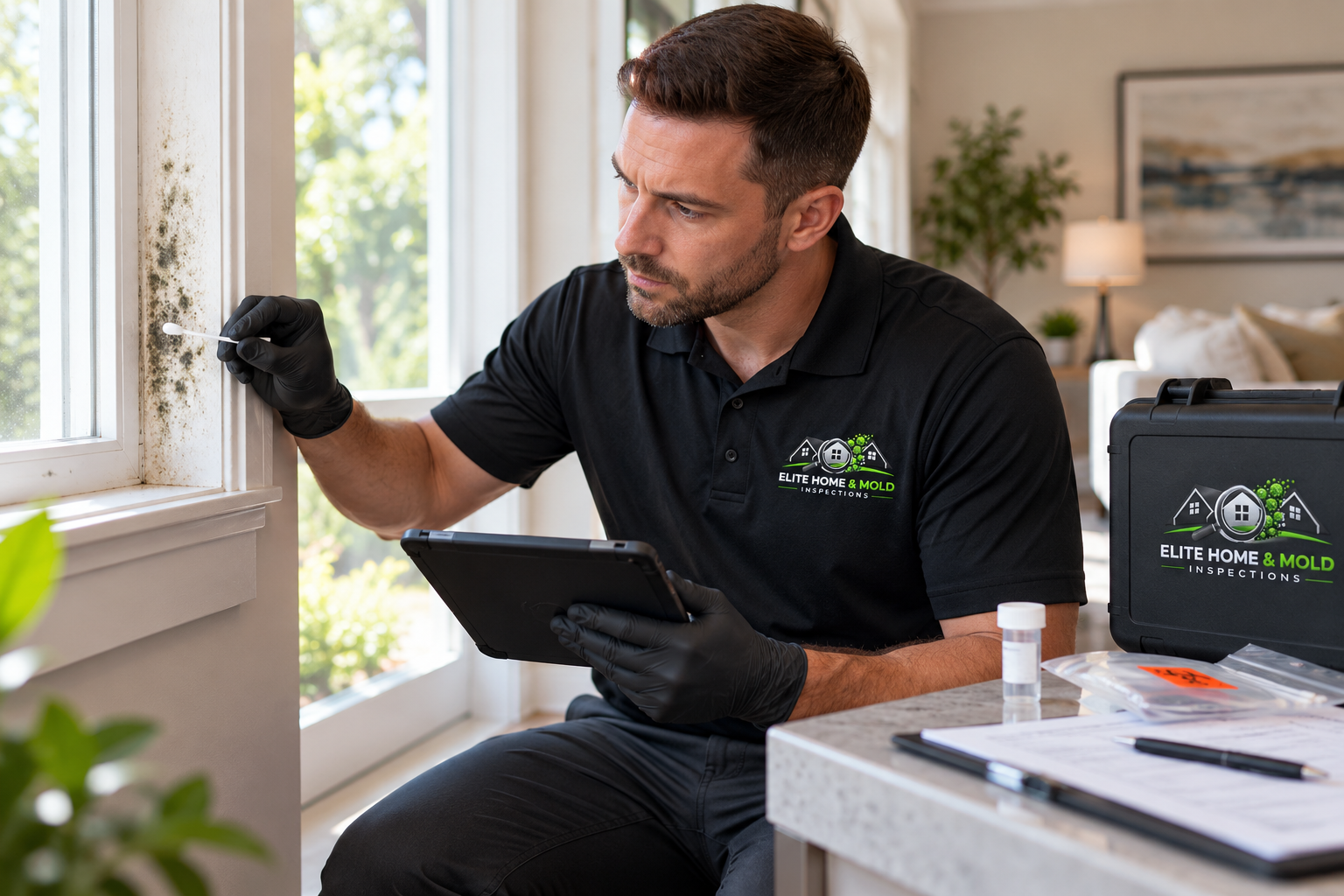
Professional mold inspector collecting a surface sample from suspected mold near a window in a Massachusetts home
✓ Independent Mold Testing

Professional Mold Testing for Homes & Buildings

Professional mold testing uses air and surface samples to collect laboratory data about suspected mold conditions in a home or building. Elite provides independent mold testing throughout Massachusetts and New Hampshire, including Boston and Greater Boston, and we do not perform mold remediation.

Independent Mold Testing

Independent testing and interpretation with no remediation conflict of interest. We do not perform mold remediation, so our role remains separate from any company that may perform cleanup.

Laboratory Analysis

Air and surface samples are submitted for professional laboratory analysis to identify mold spores or suspected microbial growth collected from the property.

Clear Testing Documentation

When mold sampling is performed, results are documented and explained in the context of the areas tested and the purpose of the sampling.

Air & Surface Mold Sampling

Sampling may include mold air testing, tape lifts, swabs, or other surface samples when those methods are appropriate for the concern being evaluated.

Not every mold concern requires testing. When the main goal is to locate a moisture source, investigate why mold is present, or evaluate building conditions, a mold inspection may be the more appropriate starting point.
Professional mold testing in a Massachusetts residential property
GET STARTED

Request Mold Testing

Complete the form below and we’ll contact you to confirm the testing requested, pricing, availability, and scheduling.


PROFESSIONAL MOLD TESTING

What Is Mold Testing?

Professional mold testing is the collection of air or surface samples for laboratory analysis. Testing can help identify mold types, measure airborne spore concentrations, compare indoor and outdoor conditions when appropriate, and document suspected microbial growth in a home or building.

✓

Air Mold Sampling

Calibrated pumps collect indoor air samples that are analyzed for airborne mold spores and reported by type and concentration.

✓

Surface Mold Sampling

Swabs, tape lifts, or other surface samples may be collected from suspected mold growth for professional laboratory identification.

✓

Outdoor Control Samples

When appropriate, an outdoor air sample may be collected as a reference for interpreting indoor airborne mold results.

✓

Independent Laboratory Analysis

Samples are analyzed by a professional laboratory to identify mold types and document airborne spore concentrations or surface findings.

Testing Provides Data — Building Context Provides Meaning

Mold test results are most useful when interpreted alongside moisture conditions, visible findings, ventilation, water-damage history, and other building factors related to the concern.

Google Guaranteed badge for Elite Home and Mold Inspections
TRUSTED BY PROPERTY OWNERS

500+ Five-Star Google Reviews

See what customers say about their experience with Elite Home & Mold Inspections.

A
Andrew Google Review
G
★★★★★

“Evan is a great guy. Was patient with my questions. Was very thorough with the inspection, explanations, and testing.”
J
Janet Google Review
G
★★★★★

“Excellent experience with Elite Home and Mold inspection service. Abe was professional, extremely knowledgeable, and very informative throughout the entire process.”

TESTING IN CONTEXT

How Mold Inspection Guides Mold Testing

Mold testing and mold inspection serve different purposes. When both are used together, the inspection helps identify moisture conditions, visible concerns, and areas where targeted air or surface sampling may provide useful laboratory data.

✓

Moisture & Water Intrusion

Moisture readings, visible damage, leaks, and water-intrusion patterns can help determine where targeted mold sampling may provide useful information.

✓

Ventilation & Humidity

Attic ventilation, basement humidity, condensation, and airflow conditions can provide important context when mold test results are interpreted.

✓

Visible or Suspected Mold Growth

Visible or suspected microbial growth can be evaluated during the inspection to determine whether laboratory identification or documentation would add useful information.

✓

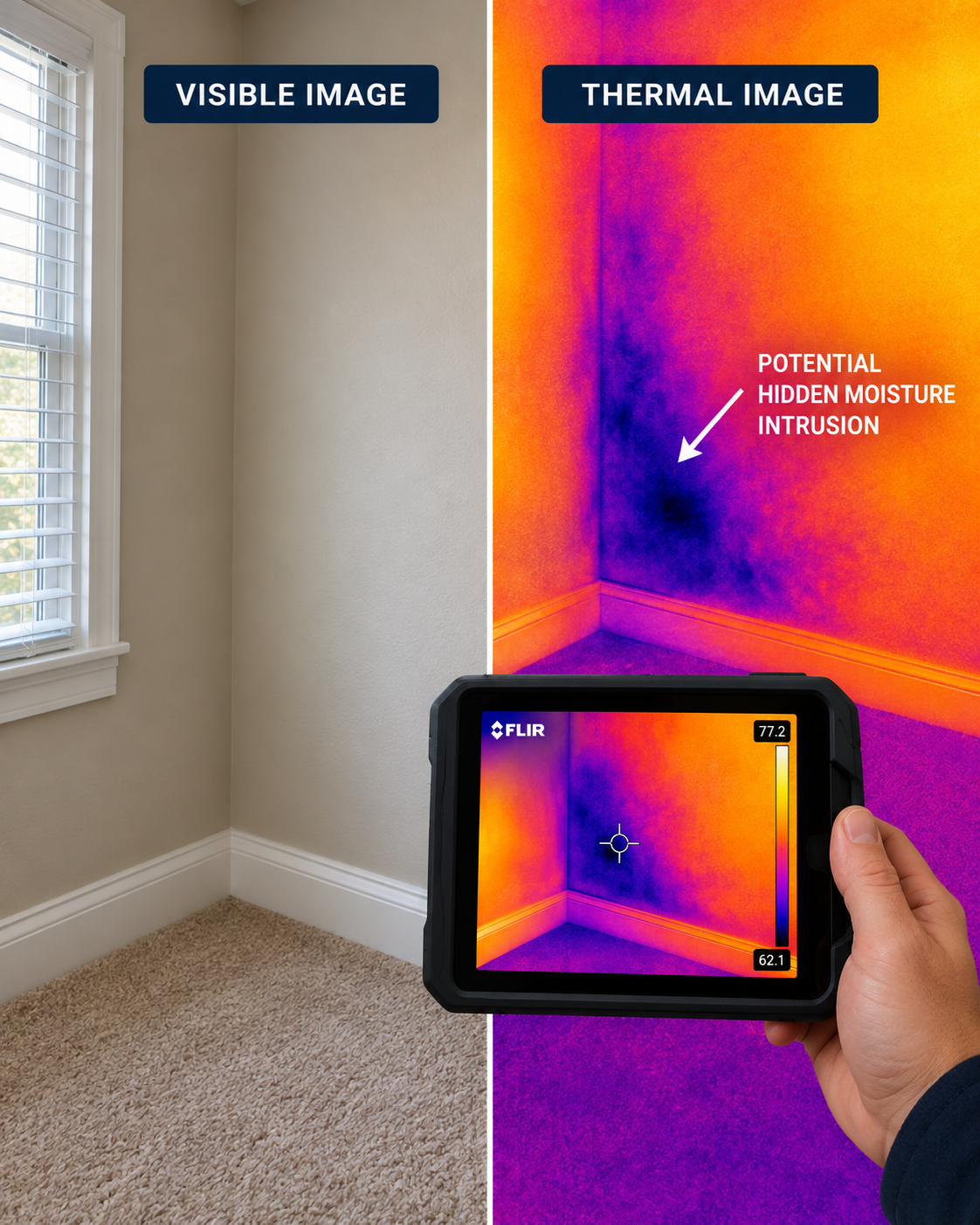
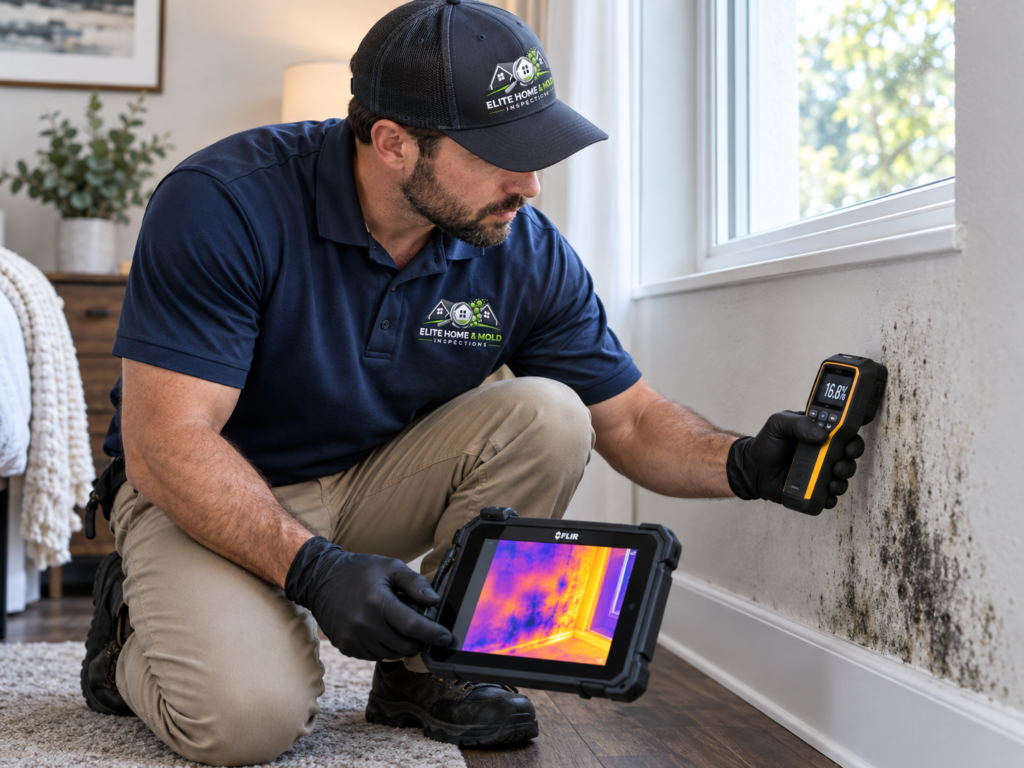
Thermal Imaging & Building Conditions

Thermal imaging, moisture readings, and evaluation of building conditions can help identify areas where targeted testing may be appropriate.

Inspection Guides the Testing Strategy

Mold testing should answer a specific question rather than simply collect samples. Inspection findings can help determine whether testing is appropriate, which areas should be sampled, and whether air sampling, surface sampling, or another approach is best suited to the concern.

If laboratory testing is not needed to answer the concern, we do not recommend sampling simply for the sake of testing.

Mold inspector using a moisture meter and thermal imaging camera during a mold inspection in Boston MA
STANDALONE MOLD TESTING

When Is Standalone Mold Testing Appropriate?

Standalone mold testing may be appropriate when independent laboratory data is needed without a full mold inspection, or when sampling is being used for a specific documentation, comparison, or verification purpose.

✓

Real Estate Transactions

Buyers, sellers, attorneys, or other parties may request independent mold testing when laboratory documentation is needed as part of a property transaction or due-diligence process.

✓

Post-Remediation Verification

Air or surface sampling may be used after mold remediation as part of an independent post-remediation verification when testing is appropriate for the project.

✓

Landlord or Tenant Documentation

Independent laboratory data may be useful when occupants, landlords, or property owners need objective documentation of mold conditions in specific areas.

✓

Musty Odors Without Visible Growth

Targeted mold air testing may provide useful information when a persistent musty odor is present but visible mold growth has not been identified.

✓

Insurance or Claim Documentation

Mold testing may be requested when laboratory documentation is needed for a property concern, insurance matter, or water-loss event.

Standalone Testing Should Have a Clear Purpose

When standalone mold testing is appropriate, air or surface samples are collected to answer a specific question and submitted for professional laboratory analysis. If testing is unlikely to add useful information, a mold inspection may be the more appropriate starting point.

TYPES OF MOLD TESTING WE PERFORM

Professional Air Mold Testing

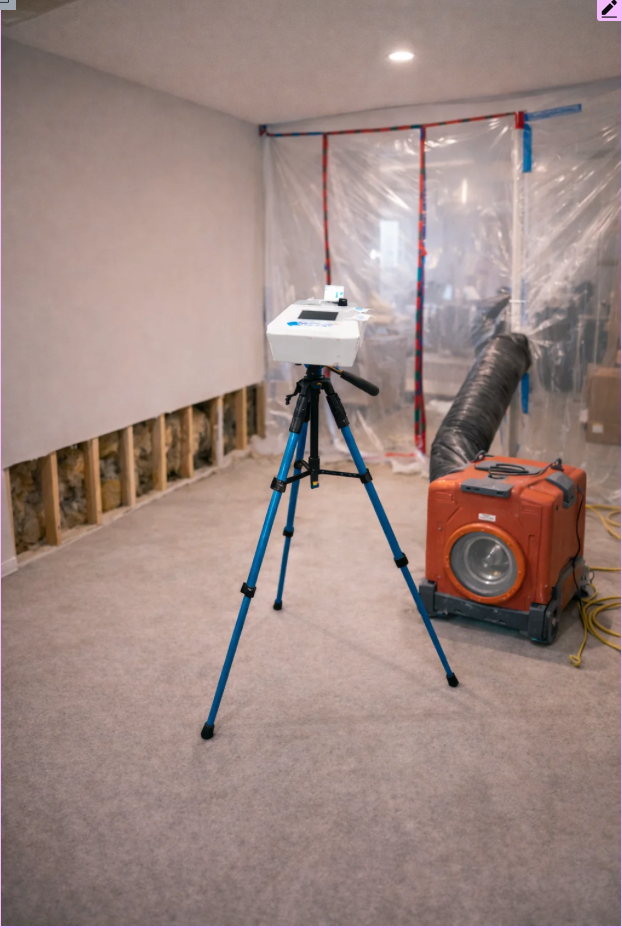
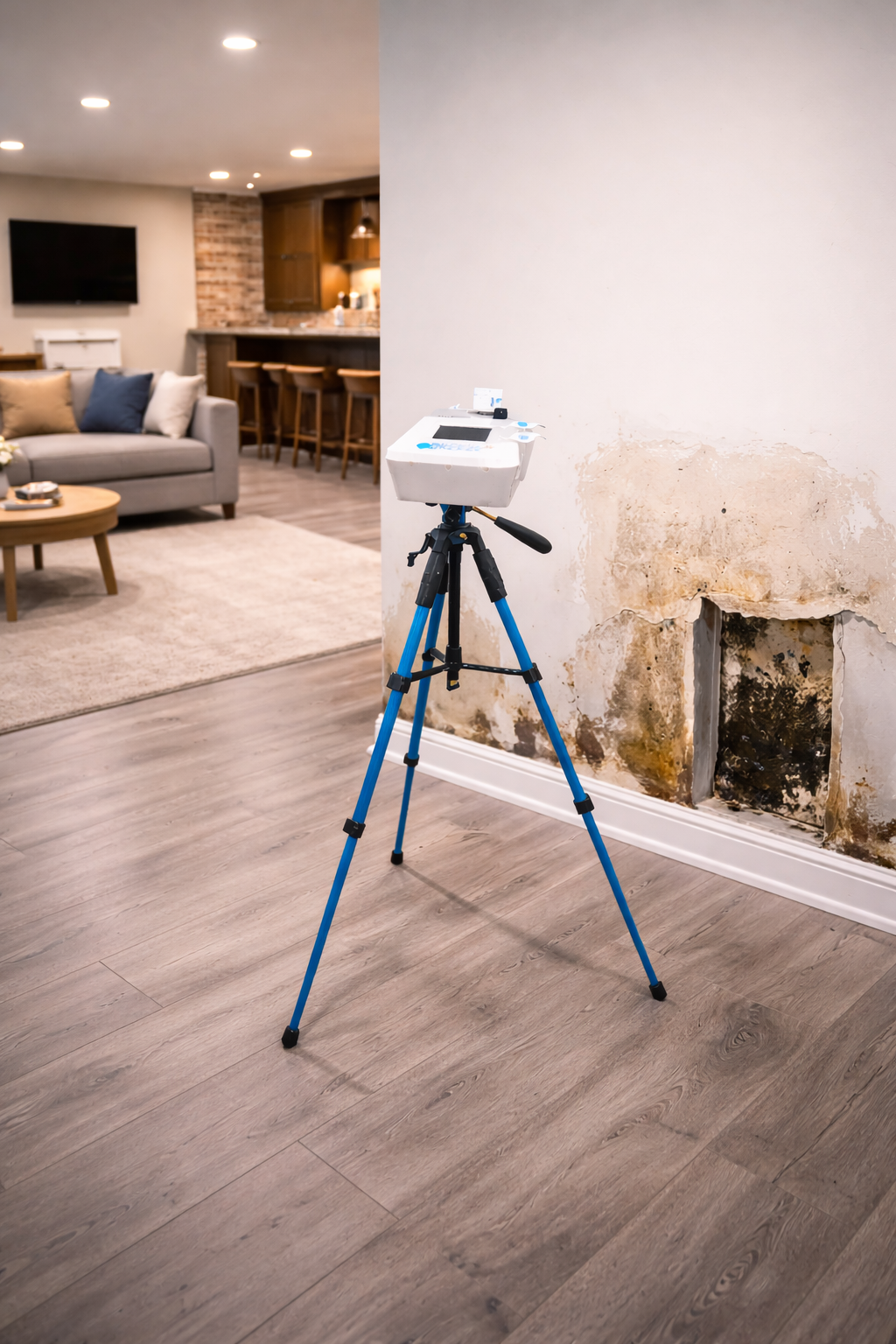
Air mold testing measures airborne mold spore concentrations inside homes and buildings. Samples are collected using calibrated air sampling pumps and laboratory cassettes, then analyzed by a professional laboratory. Air sampling can provide useful information when investigating indoor air quality concerns , hidden mold concerns, musty odors, or recent water damage. Professional air mold testing is available throughout Massachusetts and New Hampshire, including Boston and Greater Boston.

Professional air mold testing equipment used to collect airborne mold samples inside a Massachusetts residential property
Professional Air Sampling for Mold & Indoor Air Quality Evaluation

Indoor Air Mold Sampling

Indoor air samples can help identify and quantify mold spores present in occupied areas, basements, attics, or other locations of concern.

Outdoor Comparison Sample

Outdoor air may be sampled as a comparison point so indoor mold spore concentrations can be reviewed in the proper environmental context.

Laboratory Mold Identification

Laboratory analysis reports the mold types and airborne spore concentrations found in each sample for professional interpretation.

Building Conditions Provide Context

Air mold testing results are most useful when reviewed alongside moisture conditions, visible findings, HVAC operation, ventilation, and other inspection data.

Common Reasons for Professional Air Mold Testing

Hidden mold concerns, persistent musty odors, recent water damage, indoor air quality concerns, real estate transactions, post-remediation verification, and evaluation of HVAC systems as a possible pathway for airborne mold spores.

SURFACE SAMPLING

Professional Surface Mold Testing

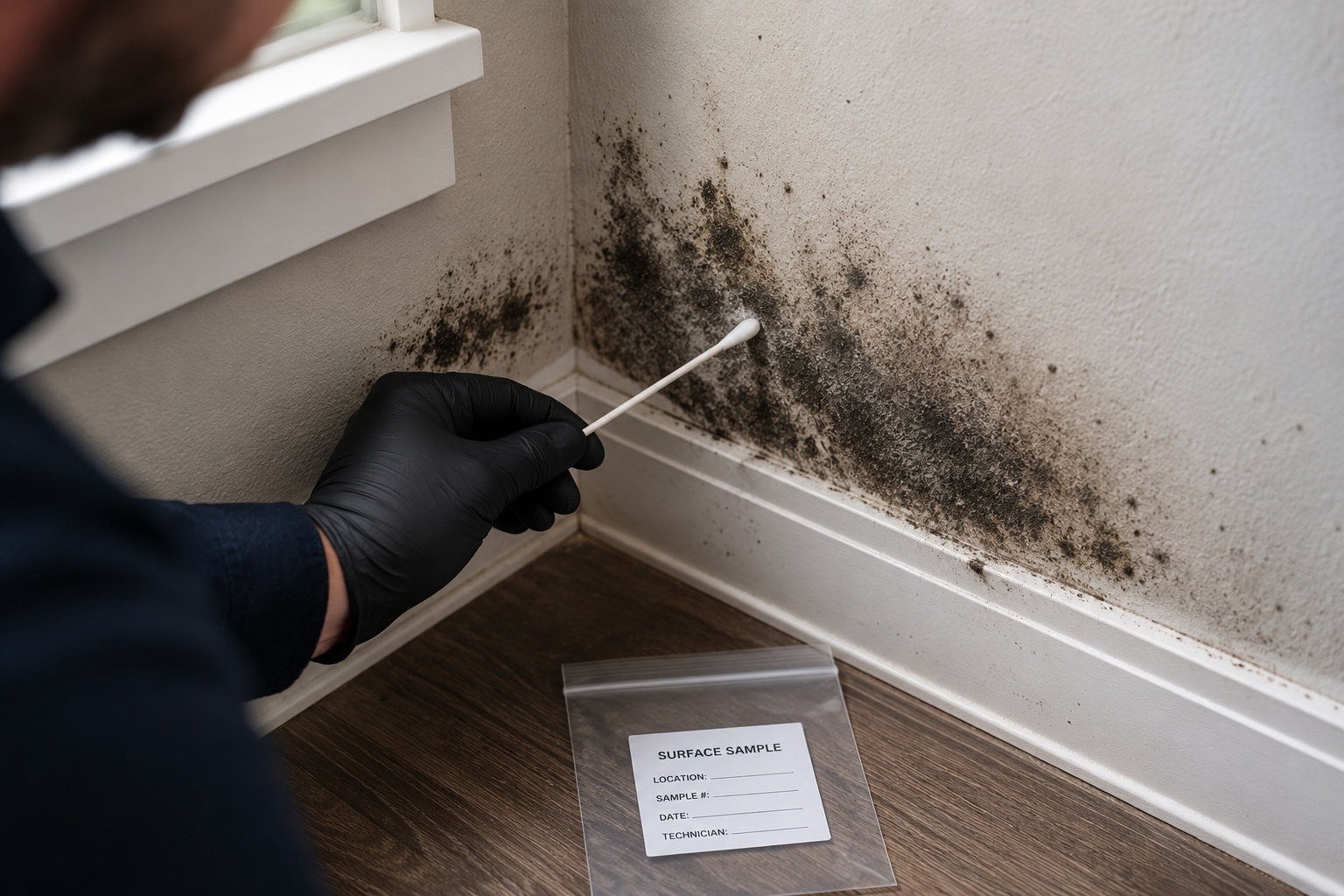
Surface mold testing collects material directly from a visible or suspected area for laboratory analysis. Depending on the condition being evaluated, samples may be collected using tape lifts, swabs, or other surface-sampling methods. Surface testing can help identify fungal material present on the specific area sampled and is available throughout Massachusetts and New Hampshire, including Boston and Greater Boston.

Professional surface mold testing sample collected from suspected mold growth in a Massachusetts home
Tape Lift & Swab Sampling for Suspected Mold Growth

Evaluate Suspected Mold Growth

Surface samples can help determine whether visible staining, spotting, discoloration, or suspected growth contains fungal material.

Laboratory Mold Identification

Laboratory analysis can identify mold types or fungal structures present in the material collected from the sampled surface.

Differentiate Mold From Other Materials

Surface testing can help distinguish suspected mold growth from dirt, soot, dust, staining, or other materials that may appear similar.

Document Mold Conditions

Surface sampling may provide laboratory documentation for property concerns, real estate transactions, insurance matters, or post-remediation verification when appropriate.

Surface Testing Represents the Area Sampled

A surface sample provides information about the specific material or location tested. It does not determine conditions in unsampled or concealed areas. Results are most useful when interpreted alongside visible conditions, moisture readings, water-intrusion history, humidity, and other relevant building factors.

POST-REMEDIATION VERIFICATION

Post-Remediation Verification (PRV) & Mold Clearance Testing

Post-remediation verification, or PRV, is an independent evaluation performed after mold remediation to document the condition of the remediated area. Depending on the project, PRV may include visual assessment, moisture evaluation, and air or surface sampling before reconstruction or reoccupancy. Independent PRV and mold clearance testing are available throughout Massachusetts and New Hampshire.

Independent post-remediation verification and mold clearance testing after mold remediation in Massachusetts
Independent PRV & Mold Clearance Testing

Visual Clearance Assessment

The remediated area is evaluated for visible dust, debris, remaining suspect growth, and overall cleanliness before clearance sampling is considered.

Moisture Evaluation

Moisture conditions may be checked to document whether affected materials and areas are appropriately dry at the time of post-remediation verification.

Air & Surface Clearance Sampling

Air or surface samples may be collected when appropriate for the remediation scope, written protocol, or specific project conditions.

Laboratory Analysis

When sampling is performed, laboratory findings are reviewed together with visual observations, moisture conditions, and the remediation scope.

PRV & Mold Clearance Testing May Be Appropriate For:
✓ Independent evaluation after mold remediation
✓ Verification before reconstruction
✓ Documentation before reoccupancy
✓ Real estate or insurance documentation
✓ Independent third-party clearance testing
✓ Projects requiring verification of remediation conditions
Independent Third-Party Mold Clearance Testing

We do not perform mold remediation. Our role is to independently evaluate the completed work and document conditions after remediation. Mold testing, when appropriate, is considered together with the visual condition of the area and relevant moisture findings rather than being used as the only measure of remediation success.

DNA-BASED DUST TESTING

ERMI Mold Testing in Massachusetts & New Hampshire

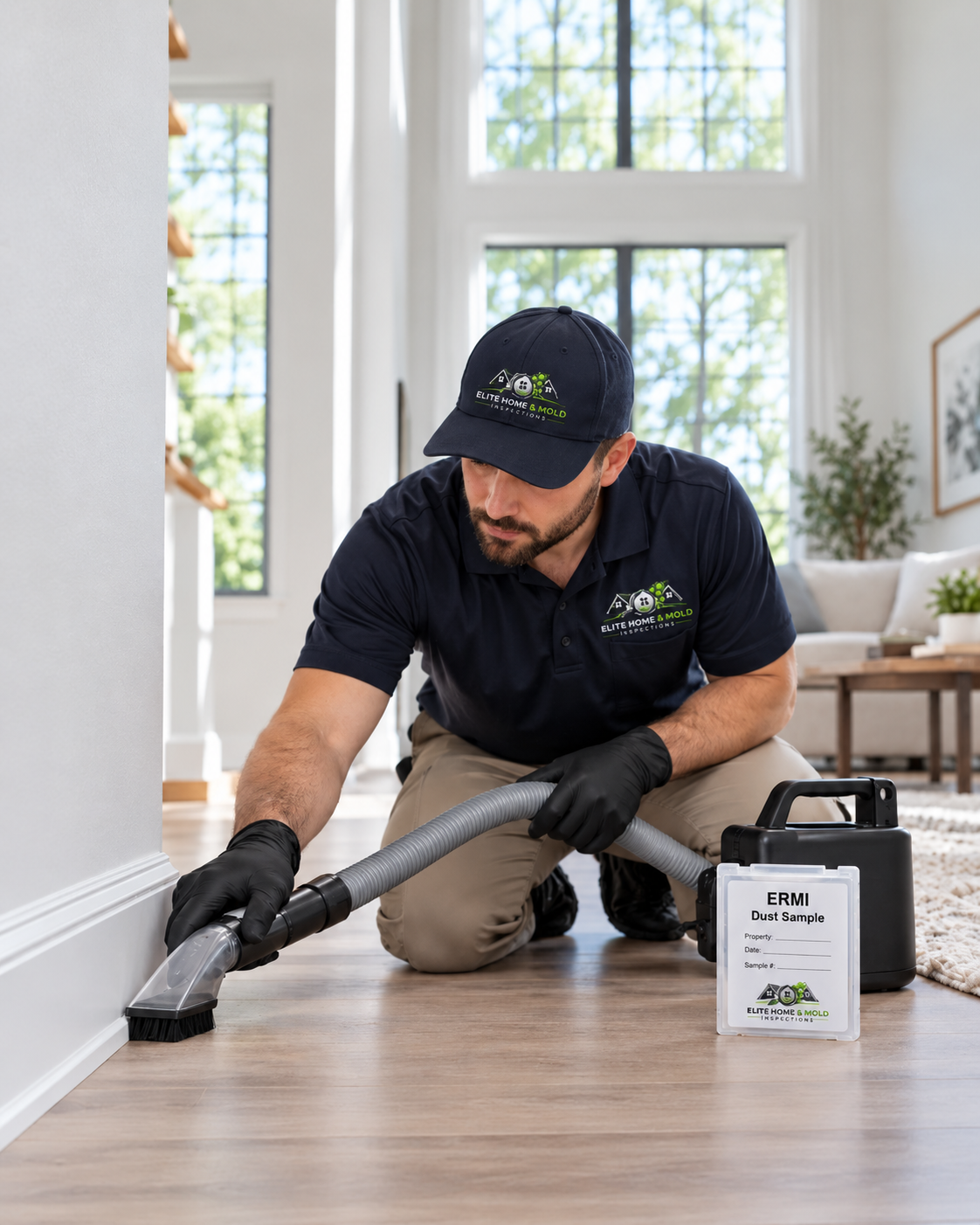
ERMI testing, or Environmental Relative Moldiness Index testing, analyzes settled dust using DNA-based laboratory methods to identify and quantify specific mold species. Unlike short-duration mold air testing, ERMI evaluates mold DNA present in collected dust and may provide additional information about the mold profile of a property. ERMI mold testing is available throughout Massachusetts and New Hampshire.

ERMI mold testing using settled dust sampling for DNA-based mold analysis in Massachusetts
ERMI Settled Dust Sampling & DNA-Based Mold Analysis

ERMI Settled Dust Sampling

ERMI samples are collected from settled dust within the property rather than from a short-duration indoor air sample.

DNA-Based Mold Testing

Laboratory analysis uses DNA-based methods to identify and quantify specific mold species detected in the collected dust sample.

Detailed Mold Species Profile

ERMI results provide information about the mold species detected in the sampled dust and the relative mold profile represented by that sample.

Environmental Relative Moldiness Index

Laboratory data is used to calculate an ERMI score that can provide additional context about the mold profile represented in the settled-dust sample.

ERMI Mold Testing May Be Considered For:
✓ Properties with a history of water damage or moisture intrusion
✓ Persistent or unresolved mold concerns
✓ Longer-term settled-dust mold profiling
✓ Real estate due diligence when ERMI data is specifically requested
✓ Detailed mold species identification
✓ Additional environmental documentation
ERMI Results Should Be Interpreted in Context

An ERMI score does not identify the location of mold growth, determine the source of moisture, or provide a complete assessment of every area of a property. Results are most useful when considered alongside moisture history, visible findings, building conditions, and other inspection or environmental testing information.

LABORATORY RESULTS & INTERPRETATION

How Are Mold Testing Results Interpreted?

Mold testing results are interpreted by reviewing the mold types and concentrations identified, the locations sampled, indoor-to-outdoor patterns when applicable, and the moisture and building conditions associated with the concern. Laboratory results should be considered in context rather than judged by a single number alone.

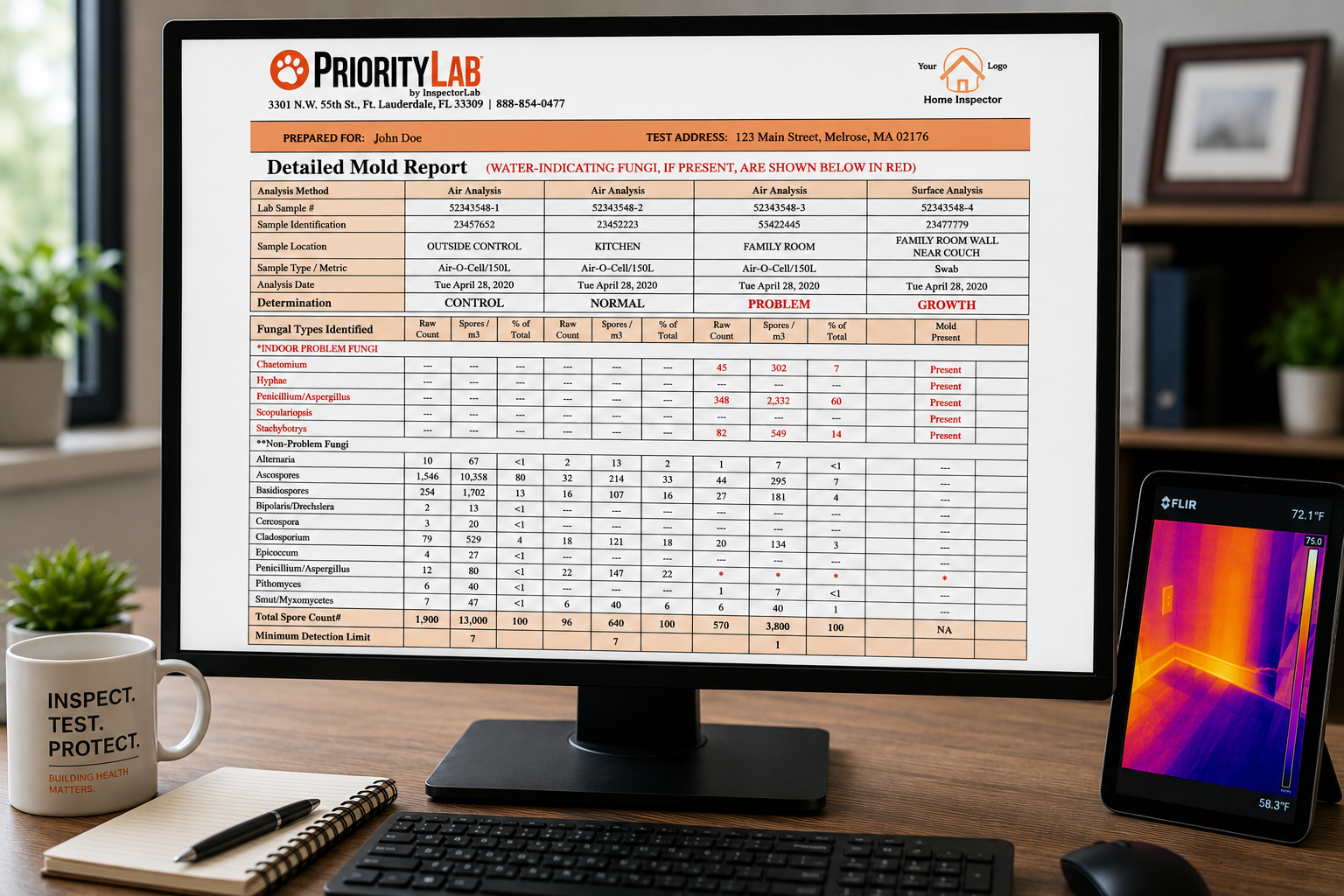
Professional interpretation of mold testing laboratory results in Massachusetts
Mold Laboratory Results & Professional Interpretation

Mold Spore Counts & Concentrations

Air-sample laboratory reports may provide total or individual airborne mold spore concentrations for each location sampled.

Laboratory Mold Identification

Reports may identify fungal genera, groups, or structures detected in the sample and help document the types of mold represented.

Indoor vs. Outdoor Mold Comparison

When an outdoor control sample is collected, indoor results can be reviewed alongside the outdoor fungal environment rather than interpreted in isolation.

Moisture & Building Context

Moisture intrusion, humidity, ventilation, water-damage history, visible growth, HVAC operation, and sample location can all affect how laboratory findings are understood.

There Is No Single Universal “High Mold” Number

Mold results should not be reduced to one spore-count number or interpreted as a simple pass or fail based on concentration alone. Laboratory data also does not identify the moisture source or determine the full extent of concealed growth. The complete sample pattern and building context are more useful than any single result viewed by itself.

Professional Mold Test Interpretation Matters

Laboratory findings are reviewed together with moisture conditions, visible observations, ventilation, HVAC operation, water-damage history, and the locations sampled so the results can be explained clearly and placed in the context of the property.

WHAT TO EXPECT

What to Expect During Professional Mold Testing

Professional mold testing should be designed to answer a specific question about the property. The testing approach depends on the concern being evaluated, the areas involved, and whether air, surface, or comparison sampling will provide useful laboratory data.

Review the Concern & Testing Goal

We review the reason for testing, areas of concern, moisture or water-damage history, musty odors, visible conditions, and the specific question the sampling is intended to answer.

Select the Appropriate Sampling Method

Depending on the purpose of the evaluation, testing may include mold air sampling, tape lifts, swabs, other surface samples, or an outdoor control sample when appropriate. Not every property requires every type of sample.

Professional Laboratory Analysis

Collected samples are submitted for professional laboratory analysis. Depending on the sampling method, reports may identify mold types, fungal structures, or airborne spore concentrations.

Results & Professional Interpretation

Laboratory findings are explained in the context of the locations sampled and any relevant moisture, building, or inspection information available for the property.

Testing Should Answer a Specific Question

Mold sampling is most useful when the reason for testing is clearly defined. If the main concern is locating moisture, identifying the source of a problem, or evaluating broader building conditions, a professional mold inspection may be the better starting point.

IMPORTANT CONTEXT

What Are the Limitations of Mold Testing?

Mold testing can provide useful laboratory data, but it does not evaluate every concealed area of a building or identify every moisture condition. Air and surface samples represent the specific locations and conditions present at the time of sampling.

Professional mold testing and moisture evaluation in a Massachusetts property
Mold testing results are most useful when interpreted alongside moisture conditions, building conditions, and other relevant property information.

Mold Test Results Are a Snapshot in Time

Airborne mold spore concentrations can change with weather, humidity, ventilation, HVAC operation, and activity inside the building.

Air Mold Testing Does Not Locate Hidden Mold

Elevated airborne mold spore levels may indicate a concern, but air sampling alone cannot identify the exact location or full extent of concealed mold growth.

Surface Mold Testing Has Limits

Swabs, tape lifts, and other surface samples identify what is present on the specific material sampled, but they do not determine conditions in unsampled or concealed areas.

Testing Does Not Identify the Moisture Source

Laboratory mold results do not explain why mold developed or identify the building condition responsible for excess moisture, water intrusion, or elevated humidity.

Mold Testing Is Most Useful in Context

Mold testing results are most useful when interpreted alongside moisture conditions, visible findings, ventilation, HVAC operation, water-damage history, and other relevant building information.

REGIONAL MOLD & MOISTURE CONDITIONS

Mold Testing in Massachusetts & New Hampshire Homes

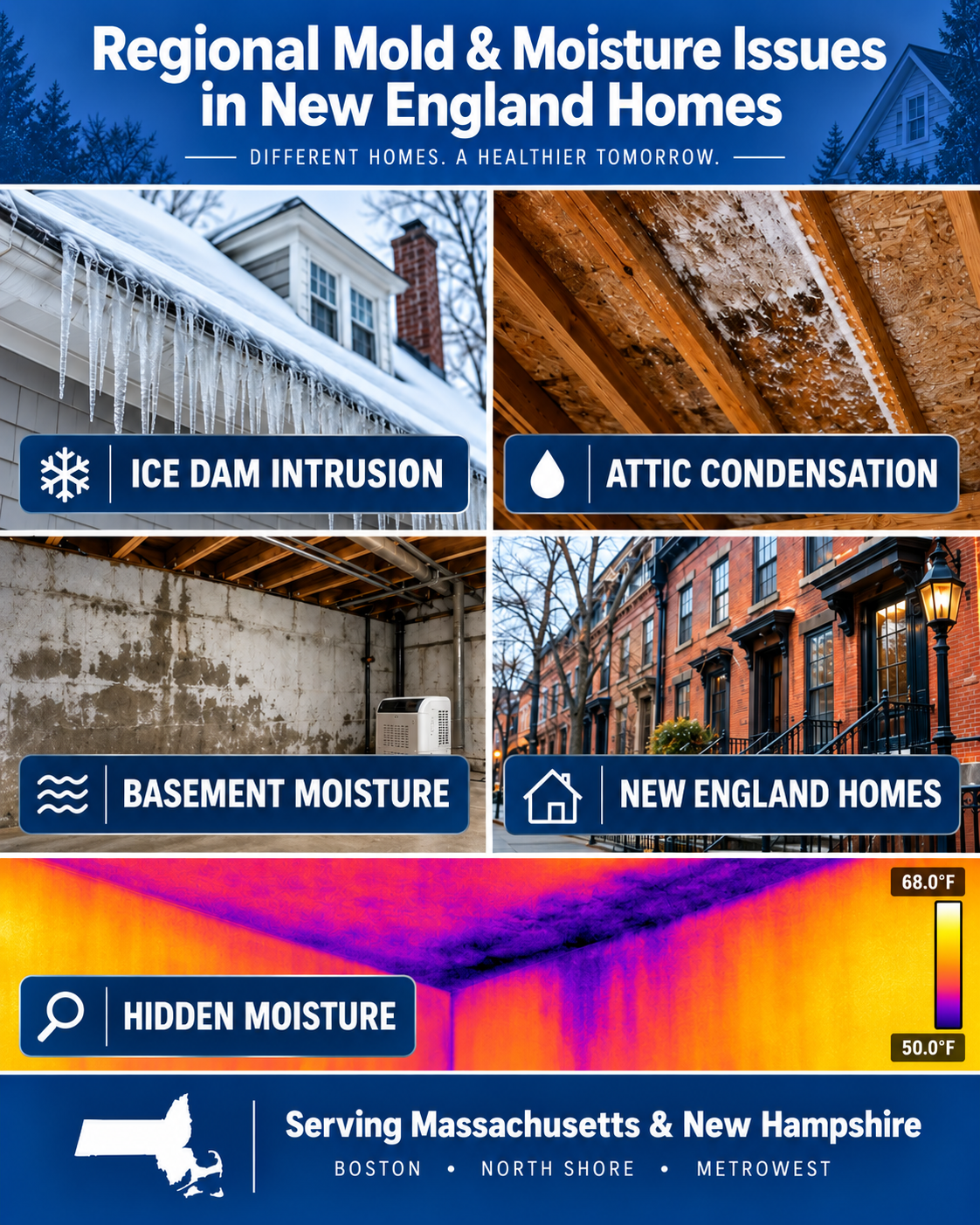
Homes throughout Massachusetts and New Hampshire, including Boston and Greater Boston, can experience seasonal moisture, ventilation, and building conditions that contribute to mold growth and affect how mold testing results should be interpreted.

Attic Mold & Condensation

Cold-weather condensation, heat loss, and ventilation deficiencies can contribute to moisture accumulation and mold growth on attic sheathing and other materials.

Basement Mold & Moisture

Groundwater, vapor migration, older foundations, plumbing leaks, and elevated humidity can contribute to mold conditions in basements and lower levels.

Ice Dams, Roof Leaks & Water Damage

Seasonal roof leakage and ice-dam moisture can affect insulation, ceilings, wall cavities, attic assemblies, and other concealed building materials.

Hidden Moisture & Concealed Mold Concerns

Air leakage, ventilation problems, plumbing leaks, condensation, and concealed moisture can influence mold growth and the interpretation of laboratory testing results.

Mold testing and moisture conditions affecting homes in Massachusetts and New Hampshire
Regional moisture and mold conditions commonly found in Massachusetts and New Hampshire homes.
Local Building Conditions Matter

From older Boston and Greater Boston homes to properties throughout Massachusetts and New Hampshire, professional mold testing is most useful when laboratory data is interpreted alongside moisture conditions, building history, ventilation, seasonal weather, and other relevant property information. For city-specific service information, see our Boston mold inspection and mold testing page.

WHY CHOOSE ELITE

Why Choose Elite for Professional Mold Testing?

Elite provides independent professional mold testing throughout Massachusetts and New Hampshire. Air and surface samples are submitted for professional laboratory analysis, and results are explained in the context of the sampled locations and any relevant moisture or building conditions available. We do not perform mold remediation.

Independent Mold Testing

We do not perform mold remediation, keeping our testing, interpretation, and recommendations independent from the company that may perform cleanup.

Experienced & Certified Inspectors

Our inspection professionals hold mold, indoor environmental, moisture, asbestos, home-inspection, and building-science credentials that support a broader understanding of property conditions.

Professional Laboratory Analysis

Air, surface, ERMI, and other appropriate samples are submitted for professional laboratory analysis based on the purpose of the evaluation.

Clear Mold Test Interpretation

We explain laboratory findings in plain language and, when relevant information is available, consider moisture conditions, visible findings, ventilation, HVAC operation, water-damage history, and sample location.

★
500+ Five-Star Reviews
30+
30+ Years Combined Experience
⌂
Local Family-Owned & Operated
View Our Credentials & Certifications

Our inspection and environmental credentials support our building-science-based approach to mold testing, moisture evaluation, indoor environmental assessment, and related services.

✓ MICRO Certification
✓ NORMI Certified Mold Inspector
✓ ACAC Council-Certified Indoor Environmentalist (CIE)
✓ BPI Building Science Principles
✓ Massachusetts Home Inspector License
✓ New Hampshire Home Inspector License
✓ Massachusetts Asbestos Inspector
✓ New Hampshire Asbestos Inspector
✓ Massachusetts Asbestos Consulting Firm
✓ New Hampshire Asbestos Consulting Firm
✓ Massachusetts Home Improvement Contractor Registration
Independent Mold Testing Across Massachusetts & New Hampshire

We serve residential and commercial properties throughout Massachusetts and New Hampshire, including Boston and Greater Boston. Our role is to provide independent testing and clear laboratory-based information — not to sell mold remediation.

MASSACHUSETTS & NEW HAMPSHIRE

Mold Testing Service Areas

Professional Mold Testing Throughout Massachusetts & New Hampshire

Elite provides independent professional mold testing for residential and commercial properties throughout Massachusetts and New Hampshire, including Boston, Greater Boston, the North Shore, MetroWest, communities north of Boston, and Southern New Hampshire. Testing may include air or surface sampling when appropriate for the property concern and purpose of the evaluation.

  • Melrose
  • Wakefield
  • Stoneham
  • Reading
  • North Reading
  • Lynnfield
  • Peabody
  • Salem
  • Marblehead
  • Swampscott
  • Beverly
  • Danvers
  • Hamilton
  • Wenham
  • Topsfield
  • Manchester-by-the-Sea
  • Gloucester
  • Ipswich
  • Newburyport
  • Manchester
  • Nashua
  • Salem
  • Windham
  • Londonderry
  • Derry
  • Bedford
  • Merrimack
  • Hudson
  • Atkinson
  • Pelham
  • Hollis
  • Amherst
  • Exeter
  • Portsmouth
  • Concord
  • Hooksett
  • Wolfeboro
  • Meredith
  • Moultonborough
  • Center Harbor
  • Tuftonboro
  • Alton
  • Gilford
  • Laconia
  • Holderness
  • New Hampton
  • Ossipee
  • North Conway
COMMON QUESTIONS ABOUT MOLD TESTING

Mold Testing FAQs in Massachusetts & New Hampshire

Answers to Common Questions About Professional Mold Testing

Below are answers to common questions about professional mold testing, air and surface sampling, laboratory results, hidden mold concerns, ERMI testing, post-remediation verification, and when testing may or may not be appropriate. Elite provides independent mold testing throughout Massachusetts and New Hampshire.

Is mold testing necessary if I already see mold?

Not always. If visible mold growth is already present and laboratory testing would not change the next step, identifying the moisture source and evaluating the affected building conditions may be more important than confirming the exact mold type. Testing may still be useful when documentation, identification, real estate due diligence, insurance records, a remediation protocol, or post-remediation verification is needed.

Can mold testing detect hidden mold?

Air mold testing may identify elevated or unusual airborne mold spore concentrations that suggest a possible concealed mold concern, but testing alone cannot identify the exact location or full extent of hidden growth. A professional mold inspection may be more appropriate when the goal is to locate moisture or investigate the source of a building problem.

What is considered a high mold spore count?

There is no single universal mold spore count that is considered “high” in every situation. Results are interpreted by reviewing the mold types identified, relative concentrations, sample locations, indoor-to-outdoor patterns when applicable, and relevant moisture and building conditions.

What is the difference between mold inspection and mold testing?

A mold inspection evaluates the property for moisture intrusion, visible or suspected mold growth, humidity, ventilation, water damage, and other building conditions. Mold testing involves collecting air or surface samples for laboratory analysis. Testing may be performed as a standalone service or as part of an inspection when laboratory data will help answer a specific question.

How does air mold testing work?

Air samples are collected using calibrated sampling equipment and submitted for laboratory analysis. The laboratory may report airborne mold types and spore concentrations for each sample. When appropriate, an outdoor control sample may also be collected as a reference for interpreting indoor results.

What is surface mold testing?

Surface mold testing collects material directly from a visible or suspected area using methods such as a tape lift or swab. Laboratory analysis can identify fungal material present on the specific surface sampled, but the result does not describe unsampled or concealed areas.

What is ERMI mold testing?

ERMI, or Environmental Relative Moldiness Index testing, analyzes settled dust using DNA-based laboratory methods to identify and quantify specific mold species. ERMI is different from traditional air sampling and does not identify the exact location of mold growth or the source of moisture. Learn more about ERMI mold testing.

What is post-remediation verification or mold clearance testing?

Post-remediation verification, often called PRV or mold clearance testing, is an independent evaluation performed after mold remediation. Depending on the project, it may include visual assessment, moisture evaluation, and air or surface sampling before reconstruction or reoccupancy. Learn more about PRV and mold clearance testing.

How long do mold testing results take?

Standard mold laboratory results are typically available within approximately 5–7 business days. Expedited laboratory turnaround may be available for some projects, with results typically returned in approximately 2–3 business days when requested and available.

INDEPENDENT PROFESSIONAL MOLD TESTING

Ready to Schedule Professional Mold Testing?

If mold testing is appropriate for your concern, Elite provides independent air and surface sampling with professional laboratory analysis throughout Massachusetts and New Hampshire. We do not perform mold remediation, so our testing and interpretation remain independent.

✓ Independent Testing
✓ No Remediation
✓ Laboratory Analysis
✓ Air & Surface Sampling
★ 500+ Five-Star Reviews
SERVING MASSACHUSETTS • GREATER BOSTON • NEW HAMPSHIRE