
ERMI Testing vs Traditional Mold Testing: What’s the Difference?
ERMI testing vs traditional mold testing involves different sampling methods and different types of information. Understanding those differences can help determine which approach may be appropriate for a particular property or concern.
Mold testing is not a single test. Different sampling methods are designed to answer different questions about a building or indoor environment.
Two approaches commonly discussed are ERMI testing and more traditional mold sampling methods such as air sampling and surface sampling. ERMI testing vs traditional mold testing is best understood as a comparison of different sampling objectives rather than interchangeable tests.
Neither method should replace a thorough inspection of the property, moisture conditions, visible growth, water intrusion, and other building conditions that may be relevant.
What Is ERMI Testing?
ERMI stands for Environmental Relative Moldiness Index. The U.S. Environmental Protection Agency describes ERMI as a research tool and notes that it has not been validated for routine non-research use. Learn more from the U.S. EPA about ERMI.
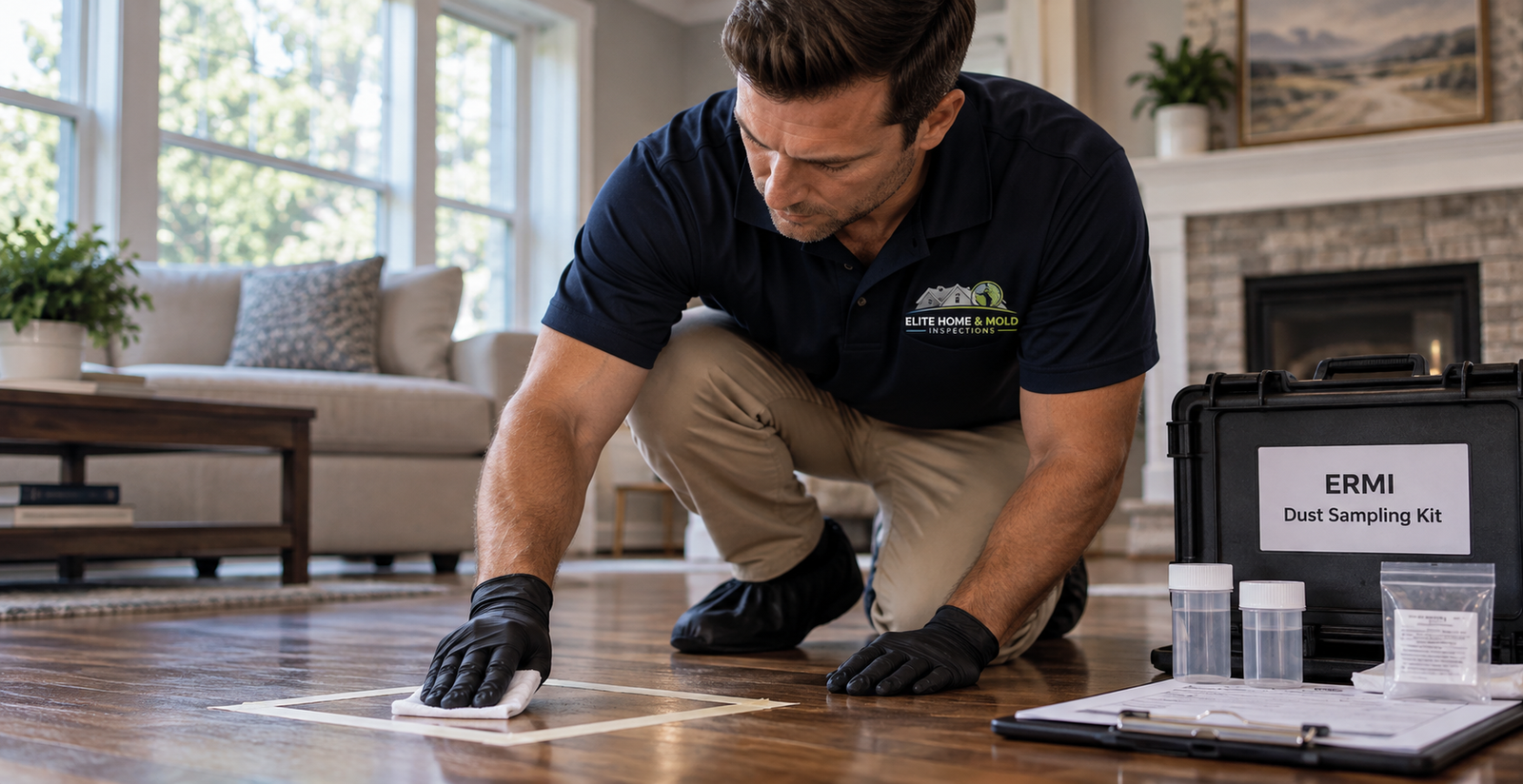
ERMI testing uses a settled-dust sample that is analyzed using DNA-based laboratory methods to identify and quantify selected mold species.
The laboratory results are used to calculate an ERMI value based on the relationship between two groups of molds included in the analysis.
Important: An ERMI result is laboratory data from a settled-dust sample. It does not by itself identify the location of moisture, determine the source of mold growth, or replace a physical inspection of the property.
What Is Traditional Mold Testing?
The phrase “traditional mold testing” can refer to several different sampling methods.
ERMI Testing vs Traditional Mold Testing: Air Sampling Differences
One of the biggest differences is the type of material being collected.
ERMI testing evaluates settled dust that may contain mold DNA accumulated over time.
Air sampling evaluates airborne fungal spores captured during a specific sampling period.
Because the two methods collect different types of material, the results should not be interpreted as interchangeable.
ERMI Testing vs. Surface Sampling
Surface sampling is generally targeted to a specific visible or suspect area.
For example, a tape lift or swab may be collected from a discolored surface when laboratory identification of the material is desired.
ERMI sampling, by comparison, evaluates dust collected from the indoor environment rather than one particular visible surface.
What Can ERMI Testing Show?
ERMI laboratory analysis can provide information about the presence and quantity of mold DNA from the species included in the test panel.
This can be useful when the goal is to obtain a broader settled-dust profile rather than a snapshot of airborne spores at one particular moment.
However, the result should still be interpreted in the context of the building, the sampling location, moisture history, visible conditions, and other available information.
What Can Air Mold Testing Show?
Air sampling can provide information about airborne fungal spores present during the sampling period.
Depending on the testing approach, indoor samples may be compared with an outdoor control sample and with samples from other areas of the building.
Air results can vary based on conditions at the time of sampling, including airflow, activity within the space, weather conditions, and other environmental factors.
What Can Surface Mold Testing Show?
Surface sampling can help identify mold or fungal structures collected directly from a particular material or surface.
This can be useful when there is visible discoloration or suspected growth and laboratory identification is desired.
A surface sample provides information about the sampled location and should not automatically be assumed to represent unrelated areas of the property.
Does ERMI Tell You Where Mold Is Growing?
Not necessarily.
An ERMI dust sample may identify mold DNA present in collected dust, but it does not automatically identify the physical source or location of that material.
If elevated or notable results are found, a physical inspection of the property may still be needed to evaluate moisture conditions, water intrusion, visible growth, and areas where mold may be developing.
Does Traditional Mold Testing Tell You the Source?
Not always.
Air and surface sampling provide laboratory information about the samples collected, but determining why mold is present or where moisture is coming from requires evaluation of the building itself.
Testing and inspection answer different questions. Laboratory results can identify or quantify material in a sample, while an inspection focuses on building conditions, moisture, water intrusion, and potential sources.
When Might ERMI Testing Be Useful?
ERMI testing may be considered when a broader settled-dust analysis is desired or when a client, consultant, or other professional specifically requests this type of testing.
Situations where ERMI may be considered can include:
- A request for DNA-based mold analysis
- A desire to evaluate settled dust rather than airborne spores
- Properties with a history of water intrusion or prior mold concerns
- Situations where a broader species profile is desired
- When ERMI testing has been specifically recommended as part of a larger evaluation
When Might Traditional Mold Testing Be More Appropriate?
Traditional sampling may be more useful when the concern is tied to a specific area, visible condition, or question.
Examples may include:
- Visible suspected mold growth
- A specific stained or discolored surface
- A localized water leak
- A particular room with a musty odor
- Airborne spore comparisons between indoor areas and outdoors
- Post-remediation sampling
Can ERMI Replace a Mold Inspection?
No testing method should automatically replace a physical evaluation of the property when the concern involves building conditions or moisture.
A mold inspection can evaluate accessible areas for:
- Visible mold-like growth
- Current or previous water intrusion
- Moisture conditions
- Plumbing leaks
- Roof or exterior water entry
- Basement and foundation moisture
- Attic condensation
- Humidity
- HVAC-related conditions
- Musty odors or staining
Sampling can then be selected based on the conditions found and the specific question being evaluated.
Is One Type of Mold Testing Better Than the Other?
Not necessarily.
ERMI, air sampling, and surface sampling are different tools. Each provides different information and has different limitations.
The more useful question is usually: What are you trying to find out?
If the goal is to evaluate settled dust for a defined panel of mold species, ERMI may be appropriate.
If the concern is airborne spores in a specific area, air sampling may be more relevant.
If the concern is a particular visible surface, surface sampling may provide the most direct information about that material.
Why the Inspection Still Matters
Mold growth is associated with moisture, so understanding building conditions remains an important part of evaluating a mold concern.
Laboratory data is most useful when it is interpreted alongside what is happening in the property.
A thorough inspection can help identify whether there is a plumbing leak, roof issue, foundation moisture, condensation, humidity problem, or another condition that may be contributing to the concern.
ERMI Testing in Massachusetts & New Hampshire
Elite Home & Mold Inspections provides ERMI testing, mold inspections, and traditional mold sampling throughout Massachusetts and New Hampshire.
Our testing approach is based on the concern, property conditions, and the type of information being requested.
We provide independent inspection and testing services and do not perform mold remediation.
With over 30 years of combined experience in the construction and environmental industries, our work focuses on evaluating building conditions and selecting appropriate testing methods when laboratory analysis is warranted.
Learn more about our ERMI mold testing services or our mold testing services in Massachusetts and New Hampshire.
Frequently Asked Questions
Is ERMI the same as an air mold test?
No. ERMI evaluates mold DNA in settled dust, while air sampling collects airborne fungal spores during a defined sampling period.
Does ERMI identify where mold is growing?
Not necessarily. ERMI can identify and quantify mold DNA in the collected dust sample, but locating the source generally requires evaluation of the property and moisture conditions.
Can ERMI be used instead of a mold inspection?
ERMI provides laboratory data, but it does not replace evaluation of visible conditions, moisture, water intrusion, or other building factors when those concerns are relevant.
Is air sampling always better than ERMI?
No. The two methods answer different questions. The appropriate method depends on what information is needed.
Does Elite perform both ERMI and traditional mold testing?
Yes. Elite Home & Mold Inspections provides ERMI testing as well as air and surface mold sampling depending on the circumstances and testing objective.
Not Sure Which Type of Mold Testing You Need?
Elite Home & Mold Inspections provides ERMI mold testing, air sampling, surface sampling, moisture evaluation, and independent mold inspections throughout Massachusetts and New Hampshire.
Serving Massachusetts & New Hampshire