
What Air Quality Testing Can Reveal in Your Home
Indoor air quality testing can provide useful information about specific contaminants and environmental conditions, but the right test depends on what is happening inside the property.
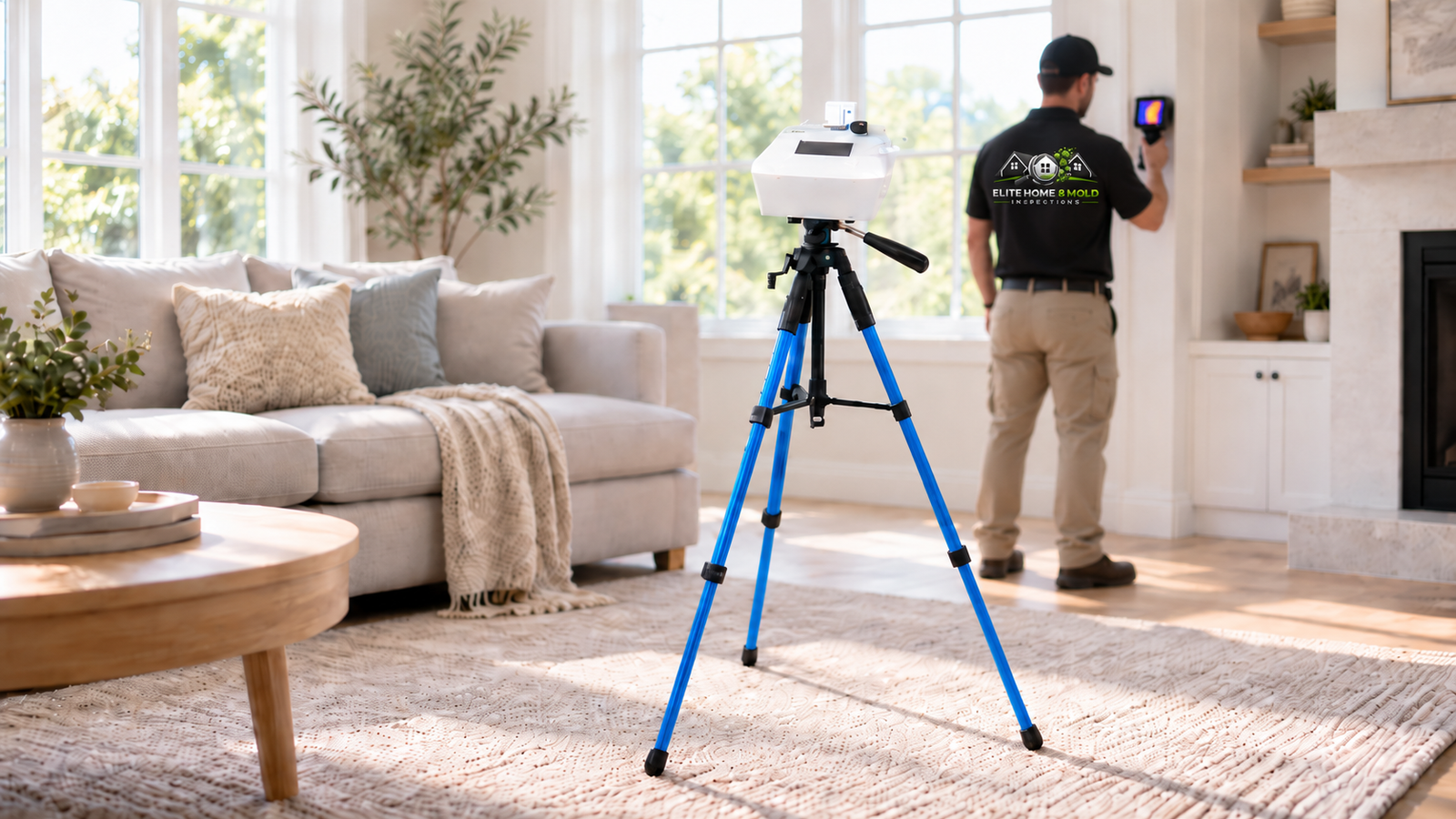
Air quality testing can provide laboratory data about selected contaminants such as mold spores, VOCs, formaldehyde, or other targeted substances. It can also be combined with moisture, humidity, and building observations to help document indoor environmental conditions.
Indoor air quality is not defined by one universal test. A home may have concerns related to moisture, mold, chemical emissions, ventilation, building materials, HVAC conditions, or a combination of several factors.
That is why a useful indoor air quality testing evaluation starts with the building and the concern being investigated rather than simply collecting samples without context.
Mold and Airborne Mold Spores
Mold air testing can provide a snapshot of airborne spores
Mold air samples can identify and quantify mold spores captured during the sampling period. An outdoor control sample is often collected for comparison when appropriate.
Results should not be interpreted by themselves. Indoor mold data is more useful when evaluated alongside visible conditions, moisture measurements, odors, water intrusion history, and accessible building materials.
If mold is the primary concern, a dedicated mold inspection may be more appropriate than broad air quality testing alone.
VOCs and Chemical Pollutants
Testing can evaluate selected volatile organic compounds
VOCs can be released by paints, adhesives, flooring, furniture, cleaning products, building materials, solvents, and other products used inside homes and buildings.
Laboratory testing can provide information about selected airborne compounds at the time the sample is collected. Concentrations can vary with ventilation, temperature, humidity, product age, and occupant activities.
Learn more about our VOC and formaldehyde testing services.
Formaldehyde
Formaldehyde is a specific volatile organic compound that may be associated with certain composite wood products, cabinetry, furnishings, flooring, adhesives, and other materials.
Targeted formaldehyde testing can provide laboratory data about the concentration measured during the sampling period. Testing does not automatically identify the exact material responsible for the measured concentration.
Moisture and Humidity Conditions
Air testing alone does not explain every moisture-related problem
Relative humidity, condensation, plumbing leaks, basement seepage, roof leaks, and past water intrusion can all influence indoor environmental conditions.
Moisture meters and thermal imaging may be used as screening tools during an inspection, but thermal imaging does not directly identify mold or moisture by itself.
When water intrusion or moisture distribution is the primary concern, moisture mapping and water intrusion documentation may provide more useful information.
HVAC and Ventilation Conditions
Indoor air conditions may also be influenced by ventilation and the HVAC system. Accessible components can be reviewed for conditions such as dust accumulation, staining, moisture, filtration issues, or other observations relevant to the investigation.
These observations do not automatically mean duct cleaning is required. Any recommendation should be based on the actual condition of the system and the broader inspection findings.
What Air Quality Testing Cannot Tell You
Testing has limitations. A sample represents conditions at a particular location and time, and results can change as building conditions change.
Air quality testing also cannot automatically identify the source of every contaminant, diagnose a medical condition, or confirm hidden mold inside inaccessible building cavities without additional evidence.
The strongest conclusions come from combining laboratory results with inspection findings and the known history of the property.
Why the Inspection Matters
A professional indoor air quality evaluation may include a visual assessment of accessible areas, moisture measurements, relative humidity and environmental measurements, thermal imaging where useful, and review of accessible HVAC components.
Those observations help determine whether laboratory sampling is appropriate and which type of testing is most relevant.
Independent Indoor Air Quality Testing
Elite Home & Mold Inspections provides independent indoor air quality and environmental testing services throughout Massachusetts and New Hampshire.
We do not perform mold remediation. Keeping inspection and testing separate from remediation helps maintain an independent evaluation of the conditions observed.
Frequently Asked Questions
Is there one test that checks everything in the air?
No. Mold, VOCs, formaldehyde, and other indoor environmental concerns generally require different sampling methods. Testing should be selected based on the concern being investigated.
Can air quality testing find hidden mold?
Air sampling may detect airborne mold spores, but it cannot by itself confirm exactly where mold is growing or prove that mold exists inside a specific inaccessible cavity.
Does indoor air quality testing include VOCs?
VOC testing can be performed when chemical pollutants are part of the concern. It is a separate type of laboratory analysis from mold testing.
Do you provide indoor air quality testing in New Hampshire?
Yes. Elite Home & Mold Inspections provides indoor air quality and environmental testing services throughout Massachusetts and New Hampshire.
Need Help Understanding Your Indoor Air?
Schedule an independent indoor air quality evaluation with Elite Home & Mold Inspections. We provide inspection and testing services throughout Massachusetts and New Hampshire.